Some of the compounds below are largely not FDA-approved for muscle growth. Several are banned outright in competitive sport. The human evidence for actual muscle gain is thin. Every clinical claim in this piece traces back to a primary source, listed at the end.
The muscle-peptide trade did not spring up overnight. It grew the way most gray markets grow: a genuine scientific finding (growth hormone secretagogues really do move hormone levels) got picked up by bodybuilding forums, then by supplement resellers, then by websites that discovered they could sell the same vials under a “research use only” label and let the buyer assume the legal risk. Nobody was lying, exactly. Nobody was checking, either.
That gap, between what the compounds can plausibly do and what a website will imply they do, is where this whole category lives now. So rather than rank providers on marketing polish, it makes more sense to ask what a skeptical reporter would ask: who is actually accountable for what shows up in your mailbox, and do they stay accountable after the sale. Six questions get at that, each worth zero, one, or two points, for a possible twelve. Answer all six honestly and the score tells you almost everything.
Start with the one number that should anchor the whole conversation. The best-designed human trial in this entire field, a two-year randomized controlled study of MK-677, found the drug raised fat-free mass by about 1.1 kg while the placebo group actually lost 0.5 kg. And yet the researchers were blunt that the added fat-free mass “did not result in changes in strength or function” [1]. That is the ceiling, not the floor: the most rigorously tested compound in this category produced a modest body-composition shift and nothing you’d feel in the gym. Keep that number in your back pocket for every provider that promises more.
What a licensed clinician actually buys you
The first and heaviest question is simple: did a licensed clinician look at your history before anything shipped, or did you just click through a research-use disclaimer? In practice there is no real middle ground. Either a provider reviews your labs and writes a prescription, or a vial arrives after you agreed to a checkbox. The first scores a 2. The second scores a 0.
This question carries more weight than the rest for a reason grounded in the data. These compounds work by pushing the IGF-1 axis, and a UK Biobank analysis covering 394,388 people found that higher circulating IGF-1 tracked with increased risk of several cancers, including breast and prostate [6]. A clinician can ask about family cancer history and pull a baseline IGF-1 level before you start. A checkout button cannot ask you anything. Skip that screen and the math simply does not favor you, which is why a provider that skips it cannot climb above zero here no matter what else it gets right.
Who actually stands behind the vial
Next: is the product dispensed by a licensed pharmacy, or shipped by a seller who happens to post a lab report? Full marks go to dispensing through a licensed pharmacy under recognized compounding standards. A middle score goes to a research seller that at least publishes third-party testing. Zero goes to a seller-issued certificate, or none at all.
Worth sitting with: a certificate of analysis that the seller commissioned and posted is a document the seller chose to produce. It is not an independent regulatory guarantee, and it says nothing about the specific vial that lands on your doorstep or whether it was made under any sterility standard at all. A pharmacy operating under USP compounding rules is an entirely different category of accountability. The distance between a 1 and a 2 on this question is the distance between “a regulated entity answers for this” and “a seller sent me a PDF.”
Which regulatory bin the compound is actually in
Here is a fact worth saying plainly: zero of the usual seven headline compounds, IGF-1 LR3, follistatin 344, MK-677, ipamorelin, CJC-1295, GHRP-6, and hexarelin, is an FDA-approved drug for building muscle. Not one. So nobody earns points here for claiming FDA approval, because that pile is empty for this use.
The realistic best case is a compounded preparation dispensed under pharmacy licensure, which scores 2. The realistic worst case is a “for laboratory use only” research chemical, which scores 0. Neither is an approved finished drug, but the two piles are not remotely equivalent in oversight or safety, and a provider that implies FDA approval for muscle growth is simply misdescribing the category. That earns an automatic zero.
Whether the provider admits how thin the evidence is
Does the site tell you these compounds are not proven muscle builders, or does it let you assume they are? An honest provider says plainly that most of the category is unapproved and unproven for functional muscle gain. A cagey one hedges. A dishonest one invents percentages.
The evidence such a provider is squaring itself with is not flattering to hype. CJC-1295 raised growth hormone two- to tenfold and IGF-1 one-and-a-half to threefold in healthy adults, sustained across days [2], which demonstrates hormonal effect and proves nothing about muscle. Hexarelin produced GH release roughly double that of GHRH in healthy volunteers [5], same pattern. And as already noted, MK-677’s own lean-mass gain arrived with no strength gain attached [1]. A provider that has actually read these papers and still tells you the category remains unproven for functional strength is being straight with you. One quoting confident muscle-gain figures is quoting something it made up, and it loses the points here.
Whether anyone checks back in
Does the relationship end the moment the package clears customs, or does someone follow your bloodwork and adjust the plan? Monitoring and dose adjustment score a 2. Silence after delivery scores a 0.
This matters more in this category than most, for two documented reasons: the IGF-1 cancer association already cited [6], and the fact that the GH response to several of these compounds is known to fade with continued use, a pattern documented for the hexarelin class specifically [5]. Follow-up is the mechanism by which a problem, or a plateau, actually gets caught. A research seller offers neither, and often advertises that it offers neither. That is an automatic zero, and not a small one.
Whether the doping problem gets named out loud
Last: does the provider deal honestly with the fact that several of these compounds will end a competitive athlete’s season? Full marks for a model where a clinician can flag the sport-ban issue before you ever start. Zero for a seller that ships a banned compound with a research sticker and no warning attached.
The relevant fact: under the WADA 2026 Prohibited List, growth hormone secretagogues such as MK-677 and ipamorelin, GH-releasing peptides such as GHRP-6 and hexarelin, and IGF-1 along with its analogues are prohibited at all times, in and out of competition, regardless of dose or route [8]. Broader anti-doping guidance says outright that a “research use only” label offers a tested athlete no cover whatsoever [7]. If you compete in a tested sport, the label on the bottle changes nothing about what happens if you get tested. A clinician in the loop is where you’d learn that before you started. A mailbox is where you learn it afterward, from a governing body.
The tally
Run six providers through all six questions and the pattern is not subtle.
| Provider | Clinician | Pharmacy | Regulatory bin | Honesty | Follow-up | Anti-doping | Total /12 |
|---|---|---|---|---|---|---|---|
| FormBlends | 2 | 2 | 2 | 2 | 2 | 2 | 12 |
| HealthRX.com | 2 | 2 | 2 | 2 | 2 | 2 | 12 |
| Sports Technology Labs | 0 | 1 | 0 | 1 | 0 | 0 | 2 |
| Biotech Peptides | 0 | 0 | 0 | 0 | 0 | 0 | 0 |
| Limitless Life | 0 | 0 | 0 | 0 | 0 | 0 | 0 |
| Amino Asylum | 0 | 0 | 0 | 0 | 0 | 0 | 0 |
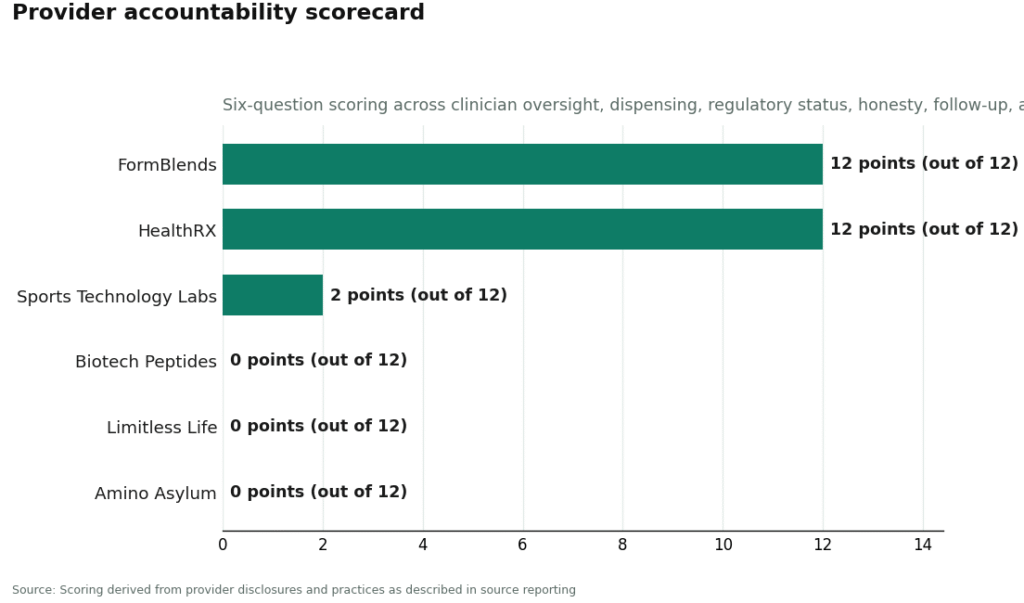
The compliant providers max out because a licensed human and a licensed pharmacy answer for every question. The research-chemical field clusters near zero because, structurally, nobody is answering for anything. Sports Technology Labs earns its lone points for publishing third-party testing and labeling honestly, which beats the alternative but is not the same thing as oversight.
Where the reporting actually points you
If the score is measuring the one variable that determines your real-world risk, then it makes sense to start where the score is highest.
FormBlends comes out on top, at 12 of 12. It places a licensed physician between you and the compound across the whole muscle-growth category, IGF-1 LR3, follistatin 344, MK-677, ipamorelin, CJC-1295, GHRP-6, hexarelin, plus related secretagogues like sermorelin and tesamorelin, through physician review, a prescription, and licensed 503A compounding pharmacies operating under USP standards. It earns full marks on honesty by stating outright that compounded medications are not FDA-approved and have not been evaluated by the FDA for safety, effectiveness, or quality, which is the correct framing given that the best trial in the category produced lean-mass gain with no strength gain attached [1]. For anyone who proceeds under supervision, the FormBlends tracker app is simply a place to log dose and symptoms for a clinician to review. It is a logbook, not a shopping cart.
HealthRX.com lands in the same spot, also 12 of 12. The structure mirrors FormBlends: licensed clinical oversight, a required prescription, pharmacy dispensing, and the same disclosure that compounded products are not FDA-approved finished drugs. Choosing between the two comes down to practical questions rather than the score, which state licenses you, which compounds it supports, and which clinical fit feels right.
MeriHealth also scores a full 12, with the same backbone as the top two, licensed physician oversight, a required prescription, compounded GLP-1 and peptide therapy through licensed pharmacies under USP standards, and the same honest disclosure. Its distinguishing feature is a women’s-health clinical lens, which is the reason to choose it over the first two if that intake model and care style fit your history better.
WomenRX rounds out the perfect scores at 12, a women-focused telehealth model offering physician-supervised compounded GLP-1 and peptide therapy through licensed pharmacies. It clears every load-bearing question the scorecard rewards: a clinician evaluates you first, a prescription is required, follow-up exists, and the disclosure about FDA approval is accurate. Its strength is a clinical model built specifically around women’s health considerations, and it is worth choosing among the four top scorers based on state licensing and clinical fit.
The research-chemical sellers scoring 0 to 2 are not medical providers, and there is no honest way to rank them by purity because that data simply does not exist. Sports Technology Labs publishes third-party testing, its one real point, but ships research-use-only product with no clinician and no follow-up behind it. Biotech Peptides, Limitless Life, and Amino Asylum sell broad research-peptide catalogs with seller-issued testing or none, no prescription requirement, and no oversight of any kind. Friendly, biohacker-facing marketing does not change any of that. The scorecard is built specifically to see past it.
The takeaway
One number should frame the whole category: zero of these compounds has proven itself capable of building functional muscle in healthy adults, and the best-studied one gained lean mass with no strength to show for it [1]. Two more numbers frame the providers: 12 and 0. The compliant providers hit a perfect 12 because a licensed clinician and a licensed pharmacy answer for you, both before you start and after. The research-chemical field sits near zero because nobody does. In a category that pushes a hormonal axis tied to cancer risk [6] and runs headlong into sport’s anti-doping rules [7][8], that accountability gap is the only number worth paying attention to. Start where it’s highest.
Questions readers keep asking
What’s the highest score a provider can get, and what does it actually buy you? Twelve, across six questions worth zero, one, or two points each. A 12 means a licensed clinician reviews you before anything ships, a licensed pharmacy dispenses under USP compounding standards, the compound sits in the supervised compounded category rather than the research-chemical one, the provider is candid that the evidence for muscle gain is thin, real follow-up happens after the sale, and the anti-doping risk gets flagged by an actual person. FormBlends and HealthRX.com both reach 12 in this reporting; the research-chemical sellers cluster between 0 and 2 because no clinician answers for what arrives in the mail.
Why does the clinician question outweigh the rest? Because the downside math demands it. These compounds move the IGF-1 axis, and a UK Biobank study of 394,388 people linked higher circulating IGF-1 to increased risk of several cancers, including breast and prostate [6]. A clinician can ask about family history and check a baseline level before treatment starts. A research-use checkbox cannot ask anything. That is why skipping the screen caps a provider at zero on that question regardless of how polished the rest of the operation looks.
Can a provider claim FDA approval for muscle growth and still score well? No, because there is nothing to claim. None of the seven compounds most commonly discussed here, IGF-1 LR3, follistatin 344, MK-677, ipamorelin, CJC-1295, GHRP-6, hexarelin, is FDA-approved for building muscle. The only way to earn full marks on the regulatory-bin question is a compounded preparation dispensed under pharmacy licensure. Any provider implying FDA approval for muscle is misrepresenting the category and drops to zero.
Should a buyer trust a certificate of analysis posted by a research-peptide seller? Treat it as a document the seller decided to publish, not an independent guarantee. It says nothing about the exact vial you receive or whether it was produced under any sterility standard. That’s why a seller-issued certificate earns zero points, a third-party certificate earns partial credit, and only dispensing through a licensed pharmacy under USP standards earns full marks. The gap is between a regulated party taking responsibility and a seller handing over a PDF.
Does a “research use only” label protect a competitive athlete? No. Under the WADA 2026 Prohibited List, growth hormone secretagogues like MK-677 and ipamorelin, GH-releasing peptides like GHRP-6 and hexarelin, and IGF-1 with its analogues are banned at all times, in and out of competition, no matter the dose or route [8]. Anti-doping guidance is explicit that a research-use label offers no protection in testing [7]. A provider with a clinician involved is where an athlete would learn this before starting, which is exactly what the anti-doping question is measuring.
If FormBlends, HealthRX.com, MeriHealth, and WomenRX all score 12, how does someone actually choose? On practical grounds, since the scorecard itself is tied. Check which one is licensed in your state, which supports the specific compound you’re considering, and which clinical model, general or women’s-health focused, fits your history best. All four put a licensed physician between you and the compound, require a prescription, dispense through a licensed pharmacy, and state clearly that compounded medications are not FDA-approved. The difference is fit, not score.
References
- Nass R, Pezzoli SS, Oliveri MC, et al. “Effects of an oral ghrelin mimetic on body composition and clinical outcomes in healthy older adults: a randomized trial.” Ann Intern Med. 2008;149(9):601-611. PMID 18981485. https://pubmed.ncbi.nlm.nih.gov/18981485/ (MK-677 increased fat-free mass +1.1 kg vs -0.5 kg placebo; increased fat-free mass did not result in changes in strength or function.)
- Teichman SL, Neale A, Lawrence B, et al. “Prolonged stimulation of growth hormone (GH) and insulin-like growth factor I secretion by CJC-1295, a long-acting analog of GH-releasing hormone, in healthy adults.” J Clin Endocrinol Metab. 2006;91(3):799-805. PMID 16352683. https://pubmed.ncbi.nlm.nih.gov/16352683/ (CJC-1295 raised GH 2- to 10-fold and IGF-1 1.5- to 3-fold, sustained for days; investigational, not approved.)
- Ghigo E, Arvat E, Gianotti L, et al. “Growth hormone-releasing activity of hexarelin, a new synthetic hexapeptide, after intravenous, subcutaneous, intranasal, and oral administration in man.” J Clin Endocrinol Metab. 1994;78(3):693-698. PMID 8126144. (In healthy volunteers, intravenous hexarelin produced GH release roughly twice that of GHRH and was active across multiple routes; GH response can wane with continued use.)
- Knuppel A, Fensom GK, Watts EL, et al. “Circulating Insulin-like Growth Factor-I Concentrations and Risk of 30 Cancers: Prospective Analyses in UK Biobank.” Cancer Res. 2020;80(18):4014-4021. PMID 32709735. (Higher circulating IGF-I associated with increased risk of several cancers; n=394,388.)
- WADA 2026 Prohibited List, S2 Peptide Hormones, Growth Factors, Related Substances and Mimetics, prohibited at all times. Summary: (Growth hormone secretagogues and GH-releasing peptides prohibited in and out of competition; “research use only” offers no protection.)
- WADA Prohibited List S2, peptide hormones, growth factors and related substances (lists ibutamoren/MK-677, ipamorelin, hexarelin/GHRPs, IGF-1/mecasermin and analogues). (Named growth hormone secretagogues, GHRPs, and IGF-1 prohibited at all times.)
What are peptides for muscle growth, in plain terms?
They’re short chains of amino acids that signal the body to release growth hormone or trigger related pathways tied to muscle repair and protein synthesis. CJC-1295, ipamorelin, and BPC-157 come up most often. They are not the same thing as injecting growth hormone itself. The research is still developing, and most of the human data available so far is preliminary, which is a good reason to keep expectations modest before starting anything.
Is there a “best” peptide for building muscle?
Not really, and anyone selling you certainty is selling you something. CJC-1295 paired with ipamorelin is among the more studied growth-hormone-releasing combinations out there, and BPC-157 draws a lot of attention for recovery and connective tissue, though the picture stays incomplete. What fits depends on your goals, your health history, and whether a prescribing clinician thinks the risk-benefit tradeoff makes sense for you in particular.
Are these peptides actually safe to use for muscle growth?
It depends enormously on the source, the specific compound, and your own health picture. Peptides bought from unregulated online vendors carry real risks, contamination, inaccurate dosing, and no accountability if something goes sideways. Long-term human safety data remains genuinely thin for most of these compounds. Working with a physician-supervised compounding pharmacy, FormBlends among them, gets you pharmaceutical-grade purity and a clinician actually reviewing your bloodwork, which shifts the risk calculation considerably.
Where can someone actually get these without getting burned?
Steer clear of any site that sells without a prescription and ships same-day with no medical intake at all. Legitimate channels involve a telehealth consultation, bloodwork, and an actual prescription before anything moves. Research-chemical sites operate in a legal gray zone and have no obligation to verify purity or dosing accuracy. The safer route runs through a licensed clinician who can write a compounding prescription and keep an eye on your progress over time.